
Honda Sensing® Explained

As part of their long-standing “Safety for Everyone” approach, Honda developed several technologies using cameras, radar, and sensors to provide warnings about imminent safety concerns and provide automatic corrective measures when needed. This collection of technologies is known as Honda Sensing®. As with so many Honda technologies, much of their development, testing, and application was done by your fellow neighbors in and around Marysville. This Honda of Marysville blog post describes how Honda Sensing works and what each component does.
The industry’s first automatic emergency braking (AEB) system on a mass-produced consumer vehicle dates back to the 2006 Acura RL. Designed to detect and mitigate collisions, the Collision Mitigation Braking System™, or CMBS™, was the first step toward creating a comprehensive suite of driver-assistive and safety technologies. The full suite of Honda Sensing systems had its debut on the 2015 Honda CR-V, and Honda has continued to improve and expand the system ever since. The industry now describes systems like Honda Sensing as Advanced Driver Assistance Systems (ADAS).
The Honda Sensing suite of technologies includes the following:
- Collision Mitigation Braking System (CMBS) with Forward Collision Warning (FCW)
- Road Departure Mitigation (RDM) with Lane Departure Warning (LDW)
- Lane Keeping Assist System (LKAS)
- Adaptive Cruise Control (ACC) with Low-Speed Follow (LSF).
Some newer Honda models also include:
- Traffic Jam Assist (TJA)
- Traffic Sign Recognition (TSR)
- Driver attention monitor.
While it also involves sensors and warnings, Blind Spot Information System with Cross Traffic Monitor is considered separate from Honda Sensing.
Most models with Honda Sensing on the road use a combination of a millimeter-wave radar system located in the grille and a monocular camera mounted at the top of the windshield. Recent models starting with the 2023 11th-generation Civic, use a new single-camera system with a wider field of detection and a faster, more powerful processor. Combined with software advances, the system is capable of more quickly and accurately identifying pedestrians, bicyclists, and other vehicles, along with road lines and road signs.
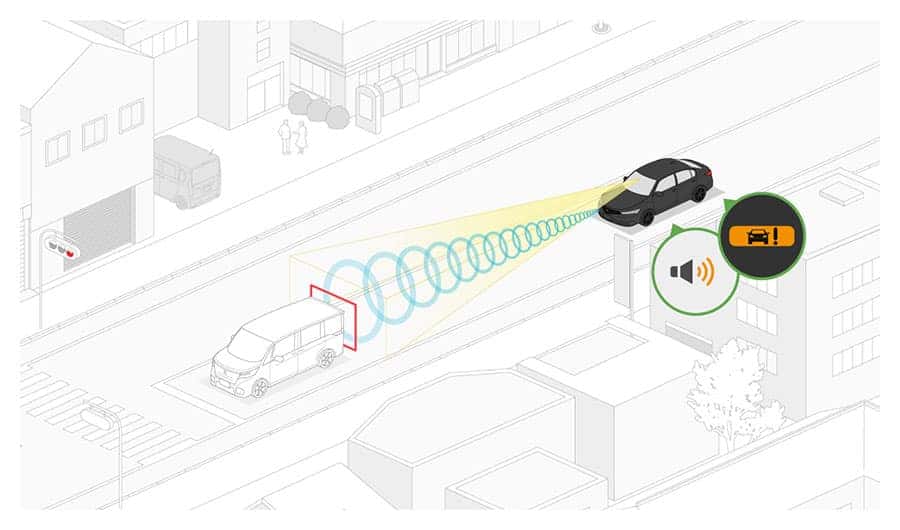
Collision Mitigation Braking System (CMBS) with Forward Collision Warning
Forward Collision Warning (FCW) uses the monocular camera to detect vehicles and pedestrians ahead while monitoring vehicle speed. If the system determines a collision may occur, it will sound an audible alert and trigger a visual warning on the instrument panel and (if equipped) Head-Up Display. If the driver fails to respond, and the system determines a collision is imminent, CMBS is activated. The vehicle’s brakes will automatically engage to help avoid or reduce the severity of a collision. Although CMBS will often stop the car, it is not intended to apply enough braking force to prevent all collisions. Also, if the system determines there is not enough time to issue an advance warning, it will engage the brakes immediately.
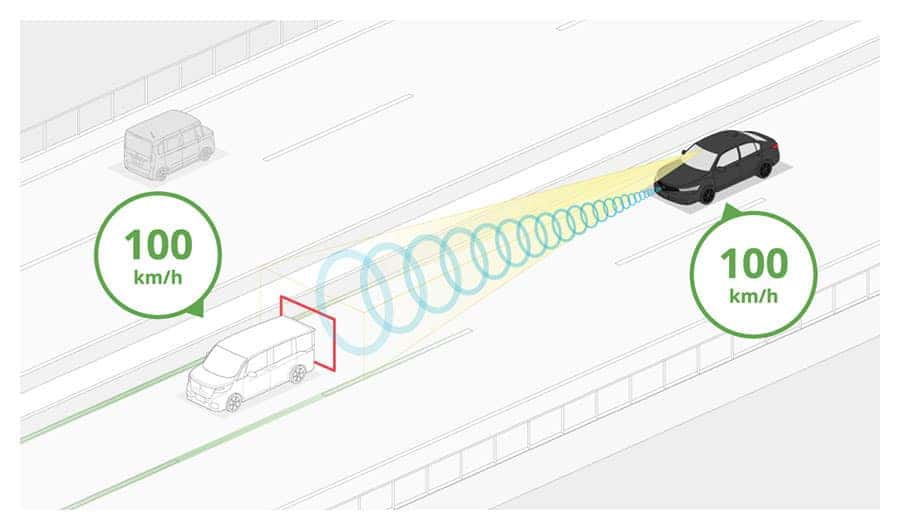
Adaptive Cruise Control (ACC) and Low-Speed Follow (LSF)
ACC allows the driver to both set a desired speed and a desired distance from a vehicle detected ahead. When a vehicle ahead travels below the set speed, your Honda will maintain the set distance behind. When the vehicle is no longer ahead, or you change to a lane that is clear ahead, the vehicle will automatically accelerate to the set speed. There are four timed distance settings from which to choose, so you can set a long distance for the open highway, and shorter distances when traffic is more dense.
LSF extends the automatic following capability of ACC to stop-and-go traffic situations (down to 0 mph). So if the detected vehicle ahead slows to a stop, your Honda will stop as well at the ACC set distance. When the vehicle pulls ahead, your Honda will not move without some action on your part which can be as simple as a tap on the accelerator or touching the SET or RES control on the steering wheel, at which point it will continue to maintain distance from the vehicle ahead.

Road Departure Mitigation (RDM) with Lane Departure Warning (LDW), Lane Keeping Assist, and Traffic Jam Assist (TJA)
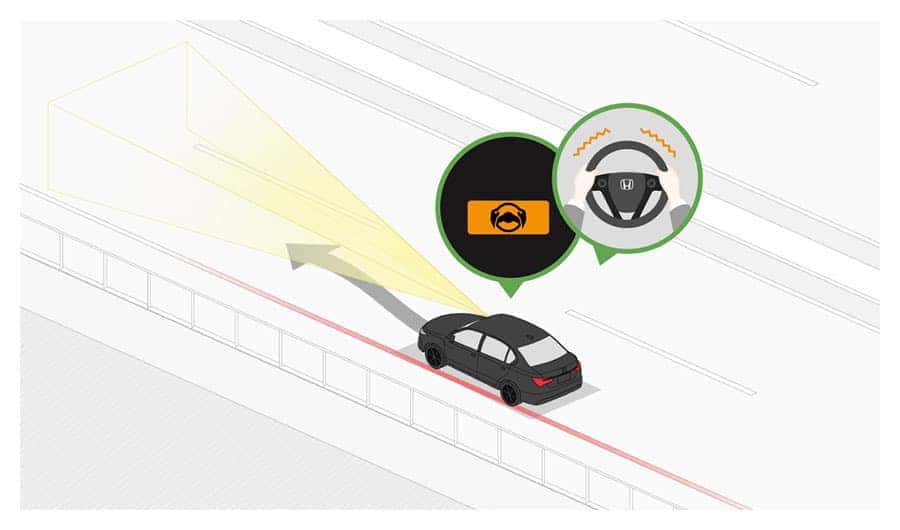
All of these systems are designed to keep you from drifting out of your lane. When engaged, the monocular camera recognizes lane markers such as solid or dashed lines, Botts’ dots, and cat’s-eye markers, and will acknowledge their identification by showing solid lane markers in the LDW graphic in the Multi-Information display. If the system detects that the vehicle is about to leave the detected lane, it displays a visual warning on the instrument panel.
If the driver does not respond, RDM will produce a warning and take corrective action by providing steering assist and/or braking to help the driver stay on the road. If necessary, the driver can easily override the steering assistance. The system can be customized in the vehicle settings, with the following modes available:
- Normal – Activates steering assist and steering wheel vibration or audible warning simultaneously.
- Wide – Activates steering wheel vibration or audible warning before steering assist.
- Narrow – When equipped, activates steering assist before steering wheel vibration or audible warning.
- Warn Only – Activates steering wheel vibration or audible warning only (no steering assist).
On relatively straight or slightly curved roads, LKAS uses light steering assist to help keep the vehicle centered in the lane at speeds of approximately 45 to 90 mph. This is not a hands-free feature, however, and if the system detects no steering input from the driver, it will issue an audio and visual warning to maintain hands on the wheel.
On vehicles so equipped, TJA extends this ability from 45 mph to a full stop, helping the driver maintain lane position in congested traffic conditions, Traffic Jam Assist is activated when both ACC and LKAS are engaged and when a preceding vehicle and lane markers are detected.
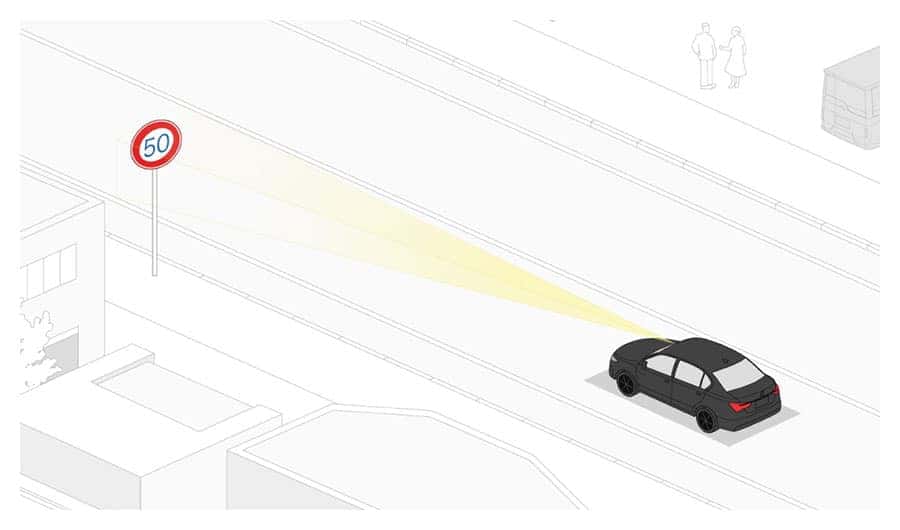
Traffic Sign Recognition (TSR)
On TSR-equipped models, the monocular camera will recognize speed limit signs and display the information on the instrument panel, and, if equipped, on the Head-Up Display. The information is displayed immediately after the vehicle passes the sign and will remain until a different sign is identified. Drivers may select between using TSR and the navigation system’s speed-limit information.
Driver Attention Monitor
Models equipped with the Driver Attention Monitor use Honda Sensing features to continually monitor the exterior conditions and driver input to assess if the driver is becoming inattentive. When Driver Attention Monitor is activated, a coffee cup icon and 4-level bar graph are displayed on the digital screen on the instrument panel. Four illuminated bars indicate full attention, but as the driver’s attention drops, fewer and fewer bars are illuminated. When the number of bars drops to two, a message inviting the driver to take a break is illuminated. If the driver continues driving and the graph drops to the lowest level of one bar, a beeper sounds, and the steering wheel vibrates, prompting the driver to pay closer attention or take a rest break.
Honda makes it very clear that no Honda Sensing feature is intended to replace the driver’s assessment of traffic conditions and control of the vehicle. The driver must intervene in certain situations and must always be attentive when using the system. In addition, drivers have the option of turning off some or all of the various functions. We invite you to visit Honda of Marysville and see how these features operate.
0 comment(s) so far on Honda Sensing® Explained